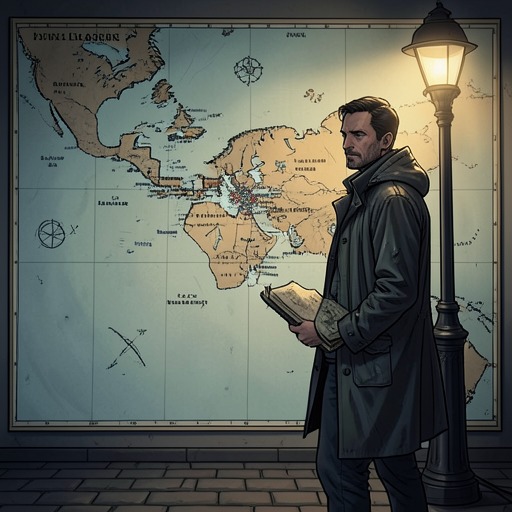
Lemuria’s submergence
Inherent ViceLemuria’s submergence is presented as an ancient inundation whose consequences persist in the geography, memory, and imagined history of the present. In Doc Sportello’s acid vision, the catastrophe turns Greater Los Angeles into a refuge for Lemurian survivors; in a broader mythic account, it sends three holy men and a sacred stone toward Indochina, where conflicts across the centuries become repetitions of an older struggle. The rising water is at once an image of a lost world and a force that makes the past seem unfinished.
The Catastrophe and Its Refugees
In Doc’s vision, the ruined city is vividly lit and resembles everyday Greater Los Angeles without quite being it. The city stretches for miles, house after house and room after room, all inhabited. Its residents include Doc and his beach neighbors, whom the vision identifies as both themselves and refugees from the disaster that submerged Lemuria thousands of years earlier. They have settled on the California coast in search of land they believe safe. The vision therefore folds the familiar beach community into an imagined migration from a vanished civilization: the people are at home in Los Angeles and displaced from somewhere impossibly remote at the same time.
The catastrophe is not simply a completed event in this vision. Doc moves through a three-dimensional urban labyrinth as water collects in its lower levels; when it reaches his ankles, he realizes that the vast structure itself is sinking. He climbs toward higher floors, but the water keeps rising. The reversal is stark: the coast that served as refuge from Lemuria’s destruction has become another place threatened by submergence. Doc begins to panic and curses Vehi, who had acted as his guide into the trip, while the city’s ordinary rooms and steps become the terrain of an imminent ancient disaster.
Lemuria, Atlantis, and Indochina
The vision connects Lemuria’s destruction to a long mythic history of war. The United States is imagined as lying between the two oceans into which Atlantis and Lemuria disappeared, positioned as the middle term in their ancient rivalry. From this perspective, the U.S. war in Southeast Asia is not an entirely self-directed conflict: it repeats a karmic loop rooted in the geography of the lost continents. The vision casts Nixon as a descendant of Atlantis and Ho Chi Minh as a descendant of Lemuria, then extends the pattern backward beyond the United States and French Indochina, beyond the Catholic Church and the Buddha, and beyond written history.
At the beginning of that imagined chain, three Lemurian holy men flee the terrible inundation that took their homeland. They bring a stone pillar rescued from their temple and establish it as the foundation and heart of their new life in exile. The stone becomes the sacred stone of Mu. As invading armies come and go, it is repeatedly removed for safekeeping and set up elsewhere when the troubles have passed. From the onset of French colonization through the U.S. occupation, it remains invisible, withdrawn into its own space. The stone’s concealed persistence gives the vision a material focus: lost Lemuria does not survive as an intact homeland, but its exiles carry an object through successive upheavals, moving it whenever power threatens to claim it.
Doc’s Vision and the Schooner
The narration leaves the precise beginning of Doc’s acid trip unclear, describing his arrival in the ancient city as occurring through an apparently simple, ordinary transition. That uncertain threshold matters: the vision does not announce a clean boundary between present-day Los Angeles and a separate mythic realm. Doc first thinks he recognizes people in the city, though he cannot always name them; the familiar and the ancient overlap before he can make sense of what he is seeing.
As the water rises, Doc senses the Lemurian spirit guide Kamukea as a shadow of deep clarity. A voice in his mind tells him that they must leave. They fly together close above the Pacific’s waves, toward dark weather on the horizon. A schooner’s sails gradually resolve out of a white blur. Doc identifies the vessel as the Golden Fang, but Kamukea silently corrects him: it is the Preserved. The distinction shifts the scene from a general image of a ship to a particular vessel, rendered with convincing physical detail—the sails work, the rigging moves, and Doc hears canvas snap and timbers creak. The ship makes the vision feel less like an abstract recollection than a world with its own solid, immediate presence.
On deck, Shasta Fay stands alone, apparently brought there under duress, looking back toward the home she has left. Doc tries to call her, but words cannot reach across the scene. Kamukea assures him that Shasta will be all right and tells him that learning not to worry is part of what the spirit guide is showing him. The vision thus places the submerged homeland, the dangerous passage across the Pacific, and Doc’s concern for Shasta within a single sequence, while leaving him unable to intervene. The ancient catastrophe is not explained away as mere scenery: it structures a lesson in separation, helplessness, and the limits of Doc’s desire to protect someone who is leaving.
Recurrence in the Present
Lemuria’s return is not confined to Doc’s trip. During the prolonged rain, Sortilège becomes increasingly absorbed in the lost civilization and its final days. She tells Doc that she dreams of Lemuria and sometimes wakes with the conviction that she had been there in a former life. Spike feels the same way, and the two have begun to share dreams. Sortilège wonders whether Lemuria is returning to them because they cannot find a way back to it; in her account, the lost place rises from the ocean and addresses them as though renewing an old acquaintance. She is unsure whether it literally speaks, and insists that it is not simply a place.
A postcard Shasta sent from an unnamed Pacific island supplies another, more concrete image of the drowned world: an underwater photograph of broken columns, arches, and collapsed retaining walls. The water is exceptionally clear and glows blue-green; tropical-looking fish swim among the ruins. The image seems familiar to Doc, but it supplies no photo credit, copyright date, or place of origin. He reads it as a message from somewhere other than the island named on the postcard and decides to revisit the address associated with the earlier Ouija-board misadventure, taking Denis along for protection. The postcard does not establish what the ruins are or how the message reached Doc. Instead, its nameless provenance preserves the uncertainty that surrounds Lemuria: the submerged city is at once an image that can be reproduced and an apparent summons whose source remains out of reach.
A Past That Does Not Stay Buried
The different appearances of Lemuria share a pattern of return without full recovery. The vision makes its refugees present in the very neighborhoods that are also recognizably Doc’s own; Sortilège and Spike experience the lost continent through shared dreams; Shasta’s postcard offers a vivid but unidentified ruin. In each case, the past becomes perceptible through fragments rather than through a stable account of the vanished civilization. Even its sacred stone survives by being hidden and moved, not by restoring the homeland that was lost.
The story’s competing scales—an ancient flood, a recurring political conflict, a psychedelic journey, and an image on a postcard—do not resolve into a single verifiable history. Instead, they make disappearance and recurrence mutually sustaining: Lemuria is gone, yet its displacement is repeated in the coast’s imagined refugees, its wars echo through later occupations, and its ruins reappear in dreams and photographs. Doc’s vision gives that pattern an intimate consequence. He can see Shasta on the Preserved and hear Kamukea’s assurance, but he cannot call her back; what remains is the demand to learn from a world whose destruction and departure cannot simply be undone.